Settling the Sheet: Scheduling Paper Conditioning Before a Litho Run

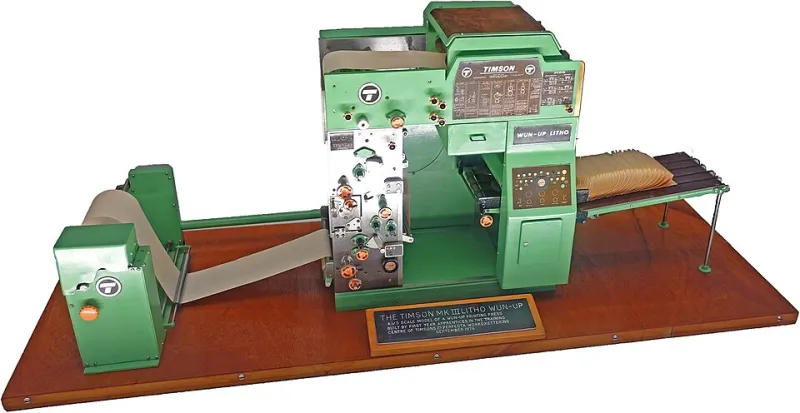
Photo: Oliver Dixon , CC BY-SA 2.0, via Wikimedia Commons
A material that keeps listening to the room
Paper is often discussed as though it were inert: a substrate chosen by weight, finish and shade, then fed through a press. In practice, it is hygroscopic. It absorbs moisture from the air and releases it again, expanding and contracting as relative humidity changes. That is not a fault in the stock. It is a property of cellulose fibres, and it continues after the paper has been cut, wrapped and delivered.
For a litho buyer, the practical consequence is simple. A sheet that has just arrived on a cold, damp morning is not necessarily in the same condition as a sheet that has been resting in a warm, dry print room for several days. If the difference is ignored, the symptoms tend to appear at the feeder or in the finished pile: wavy edges, tight centres, curled corners, sheets that resist lying flat, and a run that needs more attention than the job warrants.
Conditioning stock, or acclimatisation, is the controlled process of letting paper reach equilibrium with the environment in which it will be printed. It deserves a line in the schedule rather than a hopeful assumption.
What conditioning actually involves
Conditioning is not a single action. It is a period of managed exposure. In broad terms, the stock is brought into a pressroom or conditioned store where temperature and relative humidity are reasonably stable, and it is allowed to settle before printing. The aim is to avoid a sudden change at the point of use.
There are two variables to keep in mind. The first is temperature. A pallet delivered in winter may be much colder than the pressroom. If it is unwrapped immediately, moisture can condense on the paper surface, particularly in a warm, humid atmosphere. The second is humidity. A heated print room in February can be dry, and paper that has been stored in a damper warehouse may release moisture quickly once opened. Both directions of change can create internal stress across the sheet.
Good practice usually means allowing the wrapped pallet to stand in the pressroom long enough for its temperature to rise or fall towards the room, then opening it and allowing further time for moisture exchange. The exact period depends on the stock, the packing, the time of year and the difference between store and press conditions. Coated papers, heavy weights and tightly stacked pallets generally need more patience than a light uncoated sheet. There is no universal figure, and a responsible printer will not pretend otherwise.
What matters is that the time is planned. Conditioning is not a delay that happens when something has gone wrong. It is a stage in the production programme.
Why winter deliveries concentrate the problem
UK weather does not often produce extreme conditions, but it produces plenty of small ones. A pallet can leave a warehouse on a frosty morning, sit in a cold delivery vehicle, wait on a loading bay and then enter a heated building. Each step changes the temperature and moisture gradient through the pile. The paper may look perfectly flat under its wrapping. Open it too soon and the edges can take up moisture faster than the centre, producing the familiar wavy edge that makes a litho feeder work harder.
The reverse can happen in a dry, overheated print room. Sheets may lose moisture at the edges and curl. Either way, the press is being asked to handle a material that is still moving. That can affect register, delivery and the flatness of the finished work, especially on lighter stocks or jobs that will be folded soon after printing.
This is why conditioning is not merely a winter topic. It is a winter-sensitive topic. The risk is higher when the outside air and the inside air are most different, and when deliveries are squeezed into a busy pre-Christmas or new-year schedule.
The questions a print buyer should ask
A buyer does not need to specify a conditioning procedure in technical detail, but it is reasonable to ask how stock will be handled before the run. Useful questions include:
- When will the paper arrive, and how long will it rest before printing?
- Will it be stored in the same environment as the press, or moved in shortly before the run?
- Will the wrapping stay on during temperature equalisation, and when will it be opened?
- Are there particular risks for coated, heavy or grain-sensitive stocks on this job?
- Does the schedule allow for conditioning without eating into finishing time?
These questions are not adversarial. They help both parties understand where the slack sits. If a delivery is due on a Friday and the press is booked for Monday, there may be little room for acclimatisation. If the paper can arrive earlier and remain wrapped in a stable room, the run starts on a better footing.
A schedule item, not an insurance policy
Conditioning cannot rescue every paper problem. It will not correct a stock that has been badly stored for months, nor does it replace proper handling and sensible storage. It is a control measure, not a cure-all. But it reduces the chance that a routine litho job is complicated by sheets that are still responding to a journey and a change of air.
For print buyers, the useful shift is to treat paper conditioning as part of production planning. Ask where it sits in the timetable. Ask what happens between delivery and the first sheet. A printer who can answer plainly is likely to have thought about the material, not just the machine. And in a UK winter, that thought is worth having before the plates go anywhere near the press.