The Run Is a Range: Making Sense of Spoilage Allowances on a Litho Job
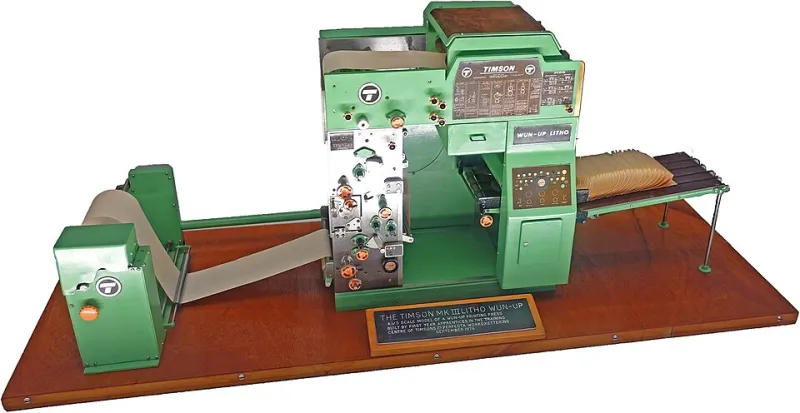
Photo: Tiia Monto, CC BY-SA 3.0, via Wikimedia Commons
A purchase order that says 5,000 brochures feels precise. In litho, it is a manufacturing target. Sheets are printed, adjusted, cut, folded, bound and packed, and each stage can consume stock. Some copies are lost to make-ready, colour setting, register, trimming, folding or binding. That loss is planned as spoilage. The quantity that arrives is therefore a range agreed before production, not a promise that every last copy will be identical to the figure on the order.
That is not a reason to accept vagueness. It is a reason to make the allowance explicit. A buyer who understands spoilage can plan stock, fulfilment and reprint triggers around a realistic band. A buyer who treats the order number as absolute will spend the last week of the job arguing about a pallet count instead of getting the material into use.
What spoilage is, and what it is not
Spoilage is material consumed in setting up and running the job. It includes make-ready sheets, press check copies, sheets removed while ink density and register are brought into line, and finishing trial sheets. It is a production cost, not a failure of care.
Spoilage is not the same as damage after delivery. Nor is it the same as an overrun. An overrun is extra good copies produced so that enough remain after spoilage. An under-delivery is a shortfall in good copies against the ordered quantity. The three are related, but they should not be blurred in the quotation.
Why the figure on the quote is not always the figure on the pallet
Printing is a physical process. Paper varies slightly between batches, presses need sheets to reach colour, and folding and binding have their own set-up. A straightforward job on a standard coated stock may lose only a small percentage. A job with special stock, heavy ink coverage, complex finishing or several component parts may lose more.
Trade custom has long allowed a tolerance around the ordered quantity, commonly expressed as a percentage either side of the target. The exact figure should be in the quotation and the order confirmation. It should not be left to habit, memory or a sentence at the bottom of an email.
Agreeing the allowance before the plates go on
The time to settle spoilage is before production, not after delivery. Ask the printer what allowance applies and how it is written into the quote. Is it plus or minus, or only plus? Are overrun copies chargeable, and at what rate? Does an under-delivery trigger a credit? Is the allowance measured in good copies packed or in sheets printed?
A phrase such as approximately 5,000 is not an allowance. A clearer line would be: 5,000 good copies, plus or minus 5 per cent, with overrun charged pro rata and under-delivery credited pro rata. The exact percentage will depend on the job, but the principle is that both sides know what the number means before paper is ordered.
For multi-part jobs, ask whether the allowance applies to each component or to the pack as a whole. A brochure with a separate reply card, for example, needs enough of both parts to make complete packs. If one component falls short, the spare copies of the other are not much use.
Stock planning: buy for the range, not the figure
Paper is the largest physical variable in most litho jobs. The printer should be able to explain the gross sheets required, the expected good copies and the paper ordered to cover spoilage. For a 5,000 run with an 8 per cent allowance, the press may need sheets for roughly 5,400 good copies, plus a sensible reserve for finishing.
That does not mean ordering paper indiscriminately. Excess stock has a cost in storage, handling and waste. The aim is a planned reserve, not a warehouse full of contingency. If the stock is bespoke, mill-made or has a long lead time, the reserve needs to be agreed early. A shortage discovered after the press has run is expensive to fix.
For repeat work, ask the printer to keep a note of the paper batch and the allowance used. If the job is likely to be reprinted, a small retained stock of the same paper can be more useful than a slightly larger overrun of finished copies.
Fulfilment and mailing: plan around a band
Mailing houses, fulfilment teams and event organisers tend to work in exact quantities. Print buyers should give them a realistic minimum rather than a single figure. If 5,000 are ordered and the allowance is 5 per cent either way, the usable quantity may be 4,750. Labels, envelopes, cartons and pack-out labour should be planned with that lower figure in mind.
Packaging specifications also need to reflect the range. If copies are packed 250 to a carton, 5,000 copies make 20 full cartons. A delivery at the lower end may produce 19 full cartons and one part carton. That is manageable if the pack-out instruction allows it. It is a problem if the fulfilment team expects only full cartons and has no process for partials.
For dated material, such as event programmes or campaign literature, decide in advance what happens if the delivery lands at the lower end. Is a shortfall acceptable? Is a top-up required? Who makes that call, and by when?
The reprint trigger
A reprint trigger is a pre-agreed point at which the buyer asks for more copies. It should be written down before production. The trigger might be a minimum acceptable quantity, a date by which the shortfall must be known, or a cost limit for a top-up run.
A top-up is rarely as cheap as the original run because it carries a new make-ready. Sometimes the better answer is to order a slightly higher initial quantity and accept a planned overrun. On other jobs, a small under-delivery is harmless and the cheapest response is to do nothing. The point is to choose deliberately rather than react in a hurry.
What to check on the quotation and delivery note
Before signing the quotation, check the quantity wording, the allowance, the treatment of overrun and under-delivery, the charge basis and the delivery quantity. Check the packing specification and the notification process if the final count is outside the expected band. If the job is for a mailing or a fixed-date event, check the reprint and top-up terms as well.
On delivery, count pallets or cartons against the delivery note and note any discrepancy. Inspect for damage and confirm the quantity of good copies before signing, or sign subject to count if the carrier permits it. A delivery note that says 5,000 is not a count. It is a statement of what the printer intended to send.
The ordered figure is a planning number. Treat it as a range, agree the range in writing, and plan stock, fulfilment and contingencies around it. That is not a loophole in the process. It is how litho works, and it is the basis of a calm delivery.