Setting the Press, Not the Price: A Buyer’s View of Make-Ready
A litho estimate arrives with a line marked ‘make-ready’. Some buyers treat it as padding; others ignore it entirely and fix their attention on the paper price. Neither response is especially useful. Make-ready is real work, carried out by real people, and it sits at the centre of what a litho press can promise on price and deadline. Understanding it does not require a press operator’s certificate, but it does require a clear view of what happens before the first sheet is good enough to sell.
From Plate to Sellable Sheet
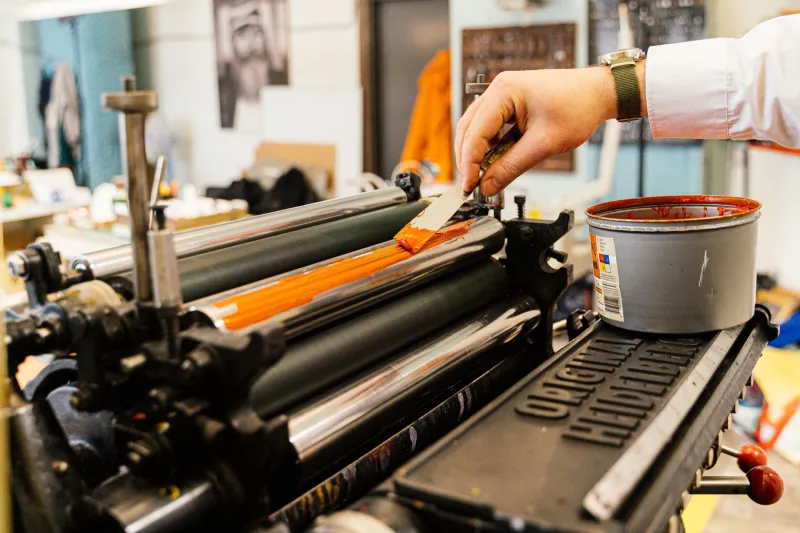
On a sheetfed litho press, the plates do not simply go on and start producing saleable work. Each plate must be mounted, clamped and registered so that every colour lands in the correct position. Blankets are washed to remove residue from the previous job. Ink keys are set across the duct so that the image receives roughly the right film of ink from the first pull. The press is then run slowly, sheets are pulled, and density readings are taken against the agreed colour target. Adjustments follow: a touch more magenta here, a little less cyan there, a wash and a re-run if the blanket picks up contamination.
The ‘first good sheet’ is not a philosophical idea. It is the point at which the sheet meets the colour tolerance and registration standard agreed for the job. A straightforward four-colour job on a well-maintained B2 press might reach that point in around twenty minutes. A job with special colours, a difficult uncoated stock or a tight deadline may take longer. The figure is not a fixed tax; it is an estimate of craft time.
The Clock Is Not a Single Figure
The mistake is to imagine that make-ready is a standard twenty minutes applied to every job. It is not. Four colours are not the same as six. A spot colour mixed to a brand reference takes more settling than a process build. Coated stock behaves differently from an uncoated sheet, and a recycled board may need more careful ink control before it stops drawing colour unevenly. Perfecting, coating and unusual formats all add steps.
Press condition matters too. A well-serviced machine with a stable ink train will settle faster than one due for maintenance. The experience of the operator is not a soft factor; it is part of the production method. None of this is an argument for vague estimates. It is an argument for estimates that state their assumptions.
Why Short Runs Feel It More
Make-ready is a fixed cost in a way that paper and ink are not. Twenty minutes of press time does not shrink because the run is 500 sheets rather than 5,000. Spread over a long run, the cost per sheet becomes modest. Spread over a short run, it becomes a visible share of the price. This is why a litho quote for a small quantity can look surprisingly high next to a digital quote, and why the same job at a larger quantity can look surprisingly competitive.
The sensible response is not to demand that make-ready disappear. It is to treat run length and make-ready as a pair. If the quantity is genuinely small, ask whether litho is the right process at all. If the quantity is likely to grow, ask how the estimate changes across a range of quantities. A printer who understands the job will usually be willing to show where the fixed costs sit.
Repeat Jobs: Familiarity, Not Immunity
Repeat work does help. Saved ink profiles, previous density readings and a known colour target can shorten the settling period. The press operator may recognise the job and know which units need watching. But a repeat is not a free pass. Plates are still mounted and registered, blankets are still washed, and the press still has to prove that this run matches the last one. Paper stock can change between deliveries, and a new batch may behave slightly differently.
A realistic repeat price reflects reduced make-ready, not the elimination of it. Buyers should be wary of a quote that implies repeats carry no setup at all; that cost will reappear elsewhere, or the promise will be quietly revised when the job reaches the press.
Questions That Help Without Micromanaging
The aim is not to stand beside the press and count sheets. It is to test the assumptions in the estimate. Useful questions include: what make-ready time is assumed for this job? Is the price based on a repeat or a first run? Does the chosen stock add time? How many spot colours are included? What tolerance defines a sellable sheet for this work? If the deadline is tight, when are the plates due on press and when is the first sellable sheet expected?
These are production questions, not accusations. A printer should be able to answer them plainly. If the answer is that make-ready has been estimated at a round figure with no reference to the job, that is worth discussing. If the answer explains that the uncoated stock and the metallic spot colour will add time, that is a sign of an estimate grounded in the pressroom.
Deadline Promises and the Honest Buffer
Make-ready is also where deadlines are quietly won or lost. A delivery date promised without accounting for press settling is an optimistic date. A realistic schedule gives the pressroom room to reach colour, allows for a wash if something contaminates a blanket, and still leaves finishing and delivery in the plan. That does not mean every job needs a week of slack. It means the promise should be built from the steps, not from wishful thinking.
For buyers, the practical lesson is simple. Make-ready is not a mysterious surcharge. It is the visible portion of the skill and time required to turn a set of plates into sellable printed sheets. Ask about it clearly, compare estimates on the same assumptions, and judge the answer by whether it fits the job in front of you. That is a more reliable route to a good litho result than treating the line as either invisible or negotiable to zero.