The Run Ends at the Loading Bay: What Holding Printed Stock Really Costs
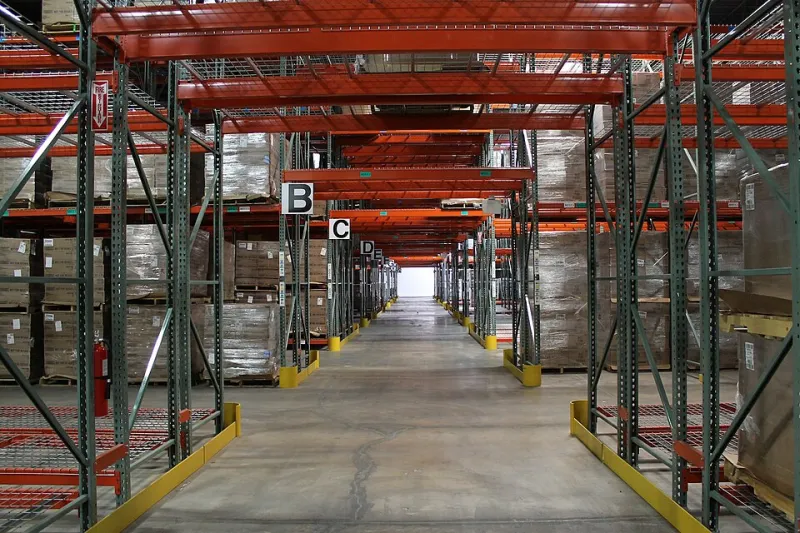
Photo: werk creative.ly, CC BY-SA 4.0, via Wikimedia Commons
The quotation for a long run is a seductive document. Twenty thousand copies, and the unit price drops by a third against five thousand. It is a real saving, honestly arrived at: the plates, the make-ready, the wash-ups and the press time are spread across far more saleable sheets. What the quotation does not show is the second half of the job, which begins the moment the pallets leave the loading bay.
Print buyers who compare a large stored run against smaller, more frequent reprints often do so on unit price alone. That comparison flatters the long run every time. The fairer question is not what a copy costs to print, but what a copy costs to print, hold, handle, protect and eventually use — or throw away.
Why the per-unit price flatters the long run
Litho is a fixed-cost process wearing a variable-cost coat. Setting a job up costs broadly the same whether you print five thousand or fifty thousand. Every extra thousand sheets after that carries ink, paper and a modest slice of press time, and very little else. So the average cost per copy falls steeply at first and then flattens.
The trap is treating that curve as a straight line into the future. It is not. Each additional copy you print beyond immediate need is a small bet that nothing about the job will change, that you have somewhere sensible to keep it, and that the stock will still be fit to use when its turn comes. Those are three separate assumptions, and each of them can fail.
What a pallet actually occupies
Storage is usually priced by the square foot, but print is bought and moved by the pallet, and pallets do not stack tidily into abstract floor area. A standard UK pallet is 1200 by 1000 millimetres. Add the working aisle you need to reach it, the clearance to the next rack, and the fact that a part-used pallet still commands its full footprint, and the true demand on a warehouse is considerably larger than the arithmetic on the carton suggests.
The practical consequence is that storing printed stock rarely costs nothing, even when it is stored on your own premises. Space that holds last autumn's brochure is space that cannot hold next spring's product. That is a real cost, even if it never appears on an invoice. Buyers who are honest with themselves will put a figure on it — the rent per square foot that the business actually pays, divided by the area the stock occupies — and then add handling.
Call-off schedules: the discipline that makes storage work
A long run only behaves like a cheap long run if the call-offs are planned before the ink is dry. Agree with your printer, in writing, how the stock will be released: the quantities per drop, the dates, the notice required, the minimum quantity per call-off, who pays carriage on each delivery, and what happens to stock that is never called off.
Small print matters here. A printer holding stock on your behalf may charge a monthly rate per pallet and a handling charge each time a pallet is picked, unwrapped and dispatched. Part-pallet drops usually cost more per copy than full-pallet ones, because the labour is the same and the load is smaller. If carriage is priced per drop, four deliveries a year cost four times one delivery, and that has to be set against the storage you are avoiding.
The other question worth asking early is where the stock will physically sit: in the printer's own warehouse, in a third-party storage facility, or on your premises. Each carries a different risk profile, a different insurance arrangement and a different set of people responsible for the condition of the stock.
Paper is a hygroscopic material, and British warehouses are British
Paper absorbs and releases moisture with the air around it. In a well-run store that is a manageable characteristic; in a cold corner of an industrial unit with a draughty roller door, it becomes a defect. Condensation, damp concrete floors and rapid temperature swings cause wavy edges, tight edges and, in bad cases, blocking — sheets that will not feed cleanly and will not register properly when they finally reach a press.
The sensible precautions are unglamorous and cheap. Keep pallets off bare concrete on boards or a pallet base, keep them away from external walls and from anything that radiates heat, and hold the space at a stable, moderate relative humidity rather than letting it swing with the weather. Leave the wrappers on until the stock is needed; a banded, shrink-wrapped pallet is a small climate of its own. Once a pallet is opened, plan to use it within a reasonable period rather than leaving the top reams exposed for a year.
Rotation, version control and the slow leak of obsolescence
Stored print does not stay current simply by existing. Phone numbers change, addresses change, prices change, and regulatory or compositional details change with them. A stock of 20,000 brochures that becomes 18,000 usable brochures after a mid-year revision is a stock that has quietly cost more per usable copy than the quotation implied.
First-in, first-out rotation, clear date labelling on every pallet and a version number visible on the outer wrap will prevent most of this. It also helps to plan the run around known change points: if a product range is refreshed each September, printing a full year's stock in March is a decision to write off whatever the refresh makes redundant.
A plainly worked comparison
Take a buyer needing 60,000 booklets over twelve months. A single run of 60,000 may cost, illustratively, 22 pence per copy. Four runs of 15,000, each with its own make-ready, might cost 27 pence. The long run saves around £3,000 on the printing line.
Now hold the stock. Twenty pallets at a trade storage rate in the region of £10 to £14 per pallet per month is roughly £2,400 to £3,400 a year, before in-and-out handling and before any carriage on interim drops. Add a modest allowance for damaged or superseded stock and the saving has largely evaporated — and the buyer has carried the risk of holding it.
Change the numbers and the conclusion changes. A stable, long-life item with confident forecasts, cheap storage and one delivery will usually justify the bigger run. A fast-moving item with short shelf life, tight cash flow or limited space will usually reward the reprint.
Questions to put to your printer before you commit
Ask what the storage rate is per pallet per month, and whether it rises after a set period. Ask for the minimum call-off quantity, the notice period required, and the carriage cost per drop. Ask what happens to stock damaged in store, who insures it while it is held, and whether you can inspect it. Ask whether the printer will hold stock at a third-party facility, and which party bears the risk if it does.
None of these questions is awkward. A printer who plans production properly will have answers ready, because the warehouse is part of the press — not a car park at the end of it.