Plates in the Rack, Figures on the File: Making a Repeat Litho Run Pay
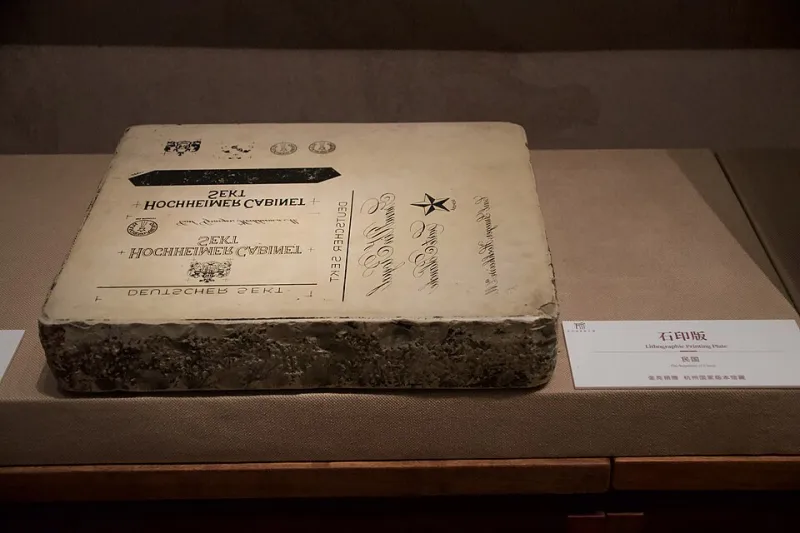
Photo: User:CatOnMars, CC BY 4.0, via Wikimedia Commons
The assumption worth testing
There is a persistent belief among print buyers that a second litho run should cost appreciably less than the first. The logic seems sound: the artwork already exists, the press has seen the job before, and nobody needs to learn anything new. In practice, the saving is real but narrower than most people expect, and it is easily lost through small changes made between the two runs.
The purpose of this article is not to puncture the idea of a repeat-run dividend, but to locate it accurately. A second impression can be quicker to make ready, more consistent in colour and less wasteful in paper. It can also be slower, dearer and harder to approve if the first run left nothing behind but a PDF and a delivery note.
What actually carries over
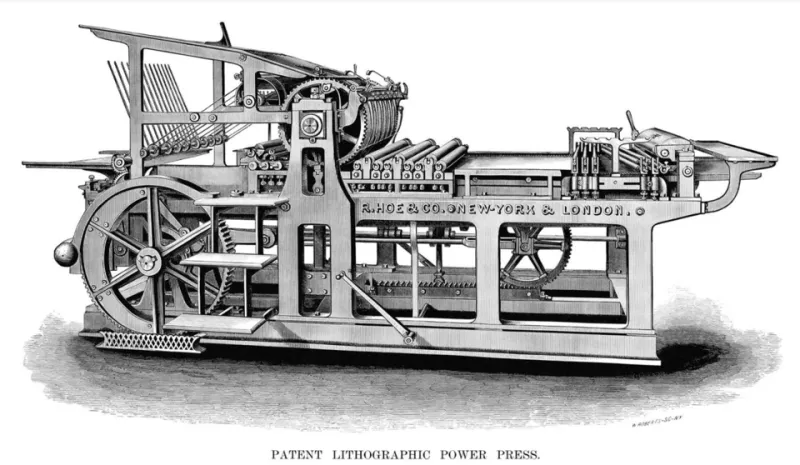
The value of a repeat run lies in information rather than hardware. Most litho plates are imaged for a single run and are not reused; a plate that has been through a full impression has done its job. Plate reuse is possible only in narrow circumstances — very short repeats, stored plates, an unchanged press and a customer willing to accept the wear — and it should not be assumed in a quotation.
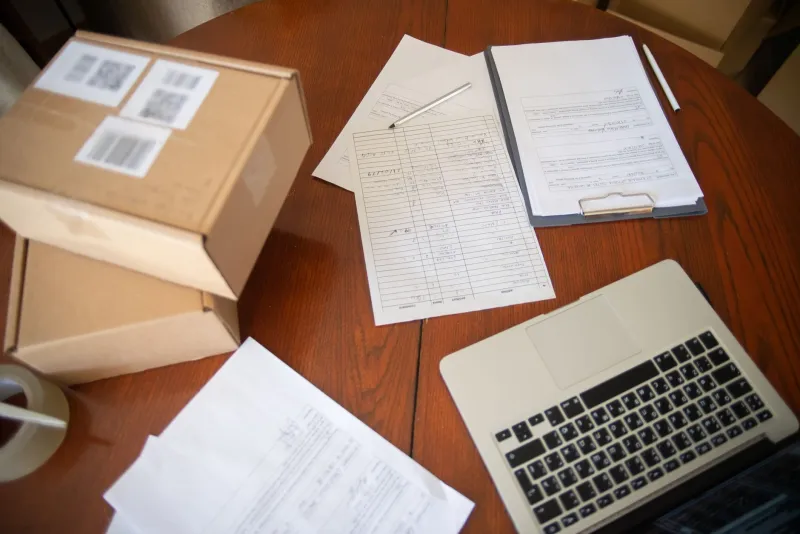
What genuinely carries over is the knowledge of how the job behaved. That includes the imposition, the ink recipes and density settings, the make-ready sheet count, the drying time before finishing, the stock specification and the approved sheet itself. A printer who recorded those things can approach the second run with fewer unknowns. A printer who did not is effectively starting again, whatever the file name suggests.
Make-ready: shorter, but not absent
Every litho run requires make-ready. Plates must be mounted, registration set, ink brought up to colour and the sheet checked against an approved copy. On a repeat, those steps are quicker because the target is known. The press operator is not searching for a colour match; they are returning to one.
The saving is usually a matter of a reduced waste sheet count and fewer press passes, not the elimination of the stage. A buyer who expects make-ready to disappear from the estimate will be disappointed. A buyer who asks the printer to record make-ready waste on the first run gives the second run a benchmark to beat.
Paper: reservation, not assumption
Paper is often the largest line in a litho estimate, and it is where repeat planning pays most clearly. If the second run uses the same stock, the printer can reserve tonnage with the merchant or mill, sometimes at a fixed price and often with a call-off arrangement. That protects the buyer from a price movement between runs and gives the printer a reason to keep the specification stable.
The saving disappears when the stock changes. A substitution to a different mill, weight or finish brings new bulk, new grain behaviour and a new set of press settings. Even an ‘or equivalent’ clause, useful as it is for deadlines, can undo the repeat-run advantage if the equivalent behaves differently on the press. Where continuity matters, name the stock and keep it named.
Ink records and colour continuity
Spot colours are where repeat runs are won or lost. A mixed ink that was recorded on the first run — recipe, batch, film weight, density — can be recreated quickly and matched to the approved sheet. Without that record, the second run begins with a fresh mix and a fresh argument about what the colour should look like.
Process colour is less fragile, but it is not immune. Press conditions, blanket wear and ink batch variation all shift the result slightly. The practical defence is an approved sheet kept in stable, dark conditions and a recorded set of density readings. The second run can then be matched to evidence rather than memory.
Where the savings evaporate
The repeat-run dividend is not a standing entitlement. It shrinks or disappears when:
- the quantity falls below the point at which make-ready is a meaningful share of the cost;
- artwork or copy changes, forcing new plates and a new approval;
- the gap between runs is long enough for paper batches, ink batches or press conditions to drift;
- the second run is squeezed into a busy period and loses the scheduling advantage;
- printed stock is held for months and the saving is eaten by storage, obsolescence or damaged edges;
- the first run left no approved sheet, no ink record and no make-ready figure.
None of these is unusual. Most are avoidable with a modest amount of discipline on the first run.
Planning the first run for the second
A repeat run is made at the quotation stage of the original job, not at the moment the reprint is requested. Four practices make the difference.
First, agree a repeat window with the printer — typically six to twelve months — and ask what can be held for that period. Plate-ready files, imposition and ink records cost little to store; press time and paper do not.
Second, ask for the make-ready waste count and the spoilage allowance to be recorded on the job sheet. These figures turn a vague promise of efficiency into something the second estimate can reflect.
Third, keep an approved sheet, not just a PDF. A physical copy signed and dated is the reference point for colour continuity, and it is the first thing a press operator will ask for.
Fourth, treat paper as a planning item rather than a purchase. A call-off reservation with the merchant, or a printer willing to hold stock for a known repeat, is often worth more than a small reduction in the first run’s price.
A realistic view of the dividend
A well-planned repeat litho run might save a modest percentage rather than a dramatic one. The gain is felt more in predictability than in headline price: fewer approval rounds, less spoilage, a colour match that holds and a schedule that does not need to be rebuilt from scratch.
That is the dividend worth pursuing. It is not a discount for loyalty, and it is not automatic. It is the return on having kept the plates in the rack and the figures on the file.