Many Audiences, One Press: Planning Litho Versions Without Losing the Run
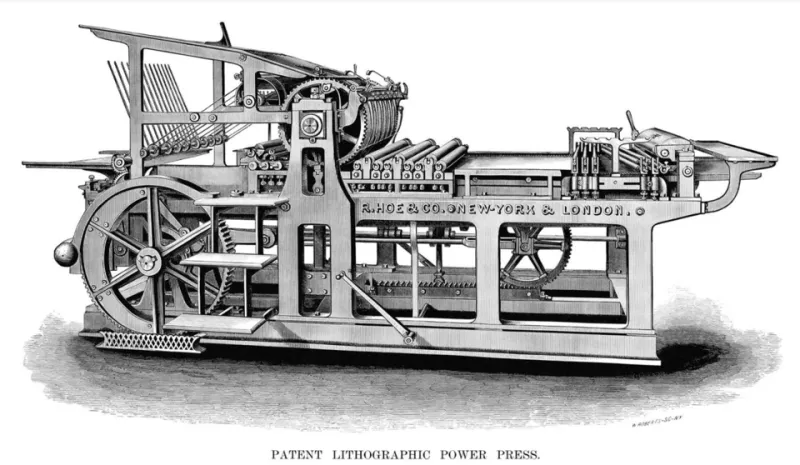
Photo: R. Hoe & Co., Public domain, via Wikimedia Commons
Versioning a litho job is often proposed as a straightforward economy: print once, vary a little, and spread the set-up cost across several audiences. That can be true, but only when the shared content is substantial and the differences are understood before the plates are made. Once a version requires its own plate set, its own make-ready and its own approval, the arithmetic changes. The useful question is not whether versions are possible, but where the common sheet ends and the genuine extra cost begins.
The Shared Sheet Is the Saving
Litho economics reward repetition. A single run absorbs the cost of plates, ink setting, registration and the early waste involved in bringing a sheet up to colour. The more impressions that share those preparations, the better the cost per copy. Versions work in the same way, but only up to a point. If four regional editions share all text pages and differ only on a cover panel, the common pages still enjoy the benefit of one long run. If each edition carries different prices, contact details and offers across eight pages, each version starts to behave like a separate job.
The practical measure is the proportion of the sheet that remains unchanged. A version that alters one colour on one side of one form is a modest interruption. A version that alters every page on both sides is a new job wearing the same title. Print buyers should ask for the estimate to show the shared elements and the version-specific elements separately, rather than accepting a single blended figure that conceals where the work multiplies.
What Actually Changes Between Versions
Versioning is sometimes discussed as though the only variable were the wording. In litho, the physical variables matter more. A change of address block in black ink is not the same as a change of background colour across a whole panel. A language variant may add copy length, alter line breaks and require a different fold. A personalised cover may be better handled at the finishing stage than by making extra litho plates.
It helps to classify each difference before briefing. Is it a plate change, an ink change, a finishing change or a distribution change? A version that differs only in the address carried on the outer envelope may not need a litho version at all. A version that differs in a sponsored panel may need one plate change on one unit. A version with a different eight-page section needs a full plate set and a separate make-ready. These are different propositions and should not be bundled under the same word.
The Version Matrix as a Briefing Tool
The most reliable way to control a versioned run is a version matrix agreed before estimating. The matrix should list each version by a short code, the audience it serves, the pages affected, the colours affected, the quantity required and the delivery point. It should also identify a master version from which all others are derived, and a change log showing what has been approved. Vague labels such as 'north' and 'south' invite confusion once artwork reaches the pressroom; coded references such as 'V1 North, V2 Midlands, V3 Scotland' are easier to check at every stage.
The matrix does more than organise artwork. It gives the printer a basis for counting plate changes, estimating make-ready time and planning the sequence on press. It also exposes awkward versions early. If one version is needed in a quantity of 300 and another in 12,000, the matrix makes that imbalance visible while there is still time to consider a digital run, a generic sheet with an overprinted panel, or a single version with a regional insert.
Plate Changes and the Make-Ready Multiplier
Make-ready is not simply repeated once per version. It is repeated per plate set and per press set-up, and the cost depends on how much of the sheet changes. A version that changes one plate on a four-colour job still requires that unit to be re-plated, re-registered and brought back to colour. A version that changes all four plates requires the full routine again. The difference between those two cases can be considerable, and it is not always obvious from a headline price per thousand.
Sequence matters too. Versions that share most plates should run together, with the changes made in a planned order. Versions that share almost nothing should be treated as separate jobs rather than forced into one schedule. Asking the printer how the versions will be sequenced is a useful test of whether the estimate has been built from the matrix or from an assumption that all versions are broadly similar.
Where Hidden Costs Appear
Several costs sit outside the plate and make-ready calculation. Each version carries its own spoilage allowance, because each brings the press back to colour. Each version has its own minimum practical run length, which may leave surplus stock. Finishing may need separation, collation or packing by version, and short version quantities can attract their own handling charge. Storage and picking become more complex when several versions are held as separate lines.
Approvals are another hidden cost. More versions mean more proofs, more colour approvals and more opportunities for a late correction. A single change after plates have been made can affect one version or all of them; the version matrix should make clear which. Distribution adds a further layer. Regional versions may need to be packed by destination, labelled separately or handed to a mailing house in a defined sequence. None of these tasks is unreasonable, but each should be priced rather than assumed.
When Versioning Pays and When It Does Not
Versioning pays when the shared content is substantial, the version quantities are large enough to absorb the extra plate work, and the differences are concentrated in predictable places. It pays less convincingly when each version is short, when every page differs, or when the approval process is likely to remain fluid. In those cases, a single generic litho run with a regional insert, a sticker or an overprinted panel may serve better. In others, a short digital run for the smallest variant may be the sensible companion to a litho main run.
The decision should be made on total cost and total risk, not on a comparison of unit prices alone. A versioned litho run that avoids separate set-ups can be excellent value. A versioned litho run that replicates set-ups for small quantities can be an expensive way to avoid saying that one audience needs a different product.
Briefing for the Pressroom
Give the printer the version matrix with the enquiry, not after the job is placed. Ask for plate changes, make-ready allowance and version-specific finishing to be itemised. Confirm which colours change on which unit, and provide artwork named to match the version codes. Keep one master document and a dated change log. If a version is added late, treat it as a new instruction with its own cost and schedule implications, not as a minor amendment.
A versioned litho run is a production plan before it is a price. The saving comes from the impressions that are shared; the cost comes from the differences that are not. Plan the differences carefully and the run can serve several audiences without losing the economy that made litho worth choosing.